Romans 7 (Mirror Word Bible)
1 I write to you in the context of your acquaintance with the law; you would agree with me that laws are only relevant in this life.
2. A wife is only bound by law to her husband while he lives; any further legal claim he has on her ends with his death.
3 The law would call her an adulteress should she give herself to another man while the first husband is still alive. Yet, once he’s dead, she is free to be another’s wife.
4 The very same finality in principle is applicable to you, my brothers, in the (crucified) body of Christ you died to the system of the law; your inclusion in his resurrection brought about a new union. Out of this marriage, (faith) now bears children unto God. (The first marriage produced sin; righteousness is the child of the new union. In the previous chapter Paul deals with the fact that our inclusion in Christ in his death broke the association with sin; now he reveals that it also broke the association with the system of the law of works as a reference to righteousness.)
5 At the time when the flesh ruled our lives, the subtle influences of sins which were ignited by the law, conceived actions within us that were consistent in character with their parent and produced spiritual death.
6 But now we are fully released from any further association with a life directed by the rule of the law, we are dead to that which once held us captive, free to be slaves to the newness of spirit-spontaneity rather than age old religious rituals, imitating the mere face value of the written code. (The moment you exchange spontaneity with rules, you’ve lost the edge of romance.)
7 The law in itself is not sinful; I am not suggesting that at all. Yet in pointing sin out, the law was in a sense the catalyst for sinful actions to manifest. Had the law not said, “Thou shalt not covet,” I would not have had a problem with lust.
8 But the commandment triggered sin into action, suddenly an array of sinful appetites were awakened in me. The law broke sin’s dormancy.
9 Without the law I was alive, the law was introduced, sin revived and I died.
10 Instead of being my guide to life, the commandment proved to be a death sentence.
11 Sin took advantage of the law, and employed the commandment to seduce and murder me.
12 I stress again that the law as principle is holy and so is every individual commandment it contains; it consistently promotes that which is just and good.
13 How then could I accuse something that is that good to have killed me? I say again, it was not the law, but sin that caused my spiritual death. The purpose of the law was to expose sin as the culprit. The individual commandment ultimately serves to show the exceeding extent of sin’s effect on humanity.
14 We agree that the law is spiritual, but because I am sold like a slave to sin, I am reduced to a mere carnal life. (Spiritual death. The word, piprasko comes from perao, meaning to transport into a distant land in order to sell as a slave. Sin is a foreign land.)
15 This is how the sell-out to sin affects my life: I find myself doing things my conscience does not allow. My dilemma is that even though I sincerely desire to do that which is good, I don’t, and the things I despise, I do.
16 It is obvious that my conscience sides with the law;
17 which confirms then that it is not really I who do these things but sin manifesting its symptoms in me. (Sin is similar to a dormant virus that suddenly broke out in very visible symptoms.) It has taken my body hostage.
18 The total extent and ugliness of sin that inhabits me, reduced my life to good intentions that cannot be followed through.
19 Willpower has failed me; this is how embarrassing it is, the most diligent decision that I make to do good, disappoints; the very evil I try to avoid, is what I do. (If mere quality decisions could rescue man, the law would have been enough. Good intentions cannot save man. The revelation of what happened to us in Christ’s death is what brings faith into motion to liberate from within. Faith is not a decision we make to give God a chance, faith is realizing our inclusion in what happened on the Cross and in the resurrection of Christ!)
20 If I do the things I do not want to do, then it is clear that I am not evil, but that I host sin in my body against my will.
21 It has become a predictable principle; I desire to do well, but my mere desire cannot escape the evil presence that dictates my actions.
22 The real person that I am on the inside delights in the law of God. (The law proves to be consistent with my inner make-up.)
23 There is another law though, (foreign to my design) the law of sin, activating and enrolling the members of my body as weapons of war against the law of my mind. I am held captive like a prisoner of war in my own body.
24 The situation is absolutely desperate for humankind; is there anyone who can deliver me from this death trap?
25 Thank God, this is exactly what he has done through Jesus Christ our Leader; he has come to our rescue! I am finally freed from this conflict between the law of my mind and the law of sin in my body. (If I was left to myself, the best I could do was to try and serve the law of God with my mind, but at the same time continue to be enslaved to the law of sin in my body. Compromise could never suffice.)
Share via Twitter Facebook etc

Don’t fear God

I have issues and I acknowledge that. My 6 year old daughter has to memorize and contemplate on 2 different verses each week for school. With my new view or paradigm of how I see God and my identity I cringe alot when I hear how God is often portrayed.
Her verse this week was Psalms103:11 this week.
New International Version
For as high as the heavens are above the earth, so great is his love for those who fear him;
I was going over it with Mo and I asked her what it meant to her… She asked why she should fear God. I told her that was a bad word (not a four letter bad word). Told her let’s replace the word fear with respect or love. She said “oh, I get it.” I walked out of the room and came back about ten minutes later. While I was gone she composed a song on her pad.

Mo
The innocence of a little child and the way they can relate blows me away. Children are not bogged down by traditions, bad teaching, works, or basic garbage. To return so easily our original identity and redeemed innocence is amazing.
How do you see God? How do you see Jesus? Riddle me this…
Share via Twitter Facebook etc

Romans 6 (Mirror Word)
1 It is not possible to interpret grace as a cheap excuse to continue in sin. It sounds to some that we are saying, “Let’s carry on sinning then so that grace may abound.” (In the previous chapter Paul expounds the heart of the gospel by giving us a glimpse of the far-reaching faith of God; even at the risk of being misunderstood by the legalistic mind he does not compromise the message.)
2 How ridiculous is that! How can we be dead and alive to sin at the same time?
3 What are we saying then in baptism, if we are not declaring that we understand our union with Christ in his death?
4 Baptism pictures how we were co-buried together with Christ in his death; then it powerfully illustrates how in God’s mind we were co-raised with Christ into a new lifestyle. (Hos 6:2)
5 We were like seeds planted together in the same soil, to be co-quickened to life. If we were included in his death we are equally included in his resurrection. (2 Cor 5:14 – 17)
6 We perceive that our old lifestyle was co-crucified together with him; this concludes that the vehicle that accommodated sin in us, was scrapped and rendered entirely useless. Our slavery to sin has come to an end.
7 If nothing else stops you from doing something wrong, death certainly does.
8 Faith sees us joined in his death and alive with him in his resurrection.
9 It is plain for all to see that death lost its dominion over Christ in his resurrection; he need not ever die again to prove a further point.
10 His appointment with death was once-off. As far as sin is concerned, he is dead. The reason for his death was to take away the sin of the world; his life now exhibits our union with the life of God. (The Lamb of God took away the sin of the world; efapax, once and for all, a final testimony, used of what is so done to be of perpetual validity and never needs repetition. This is the final testimony of the fact that sin’s power over us is destroyed. In Hebrews 9:26, “But Jesus did not have to suffer again and again since the fall (or since the foundation) of the world; the single sacrifice of himself in the fulfillment of history now reveals how he has brought sin to naught.” “Christ died once, and faced our judgment! His second appearance (in his resurrection) has nothing to do with sin, but to reveal salvation unto all who eagerly embrace him [Heb 9:28].”)
11 This reasoning is equally relevant to you. Calculate the cross; there can only be one logical conclusion: he died your death; that means you died unto sin, and are now alive unto God. Sin-consciousness can never again feature in your future! You are in Christ Jesus; his Lordship is the authority of this union. (We are not being presumptuous to reason that we are in Christ! “Reckon yourselves therefore dead unto sin” The word, logitsomai, means to make a calculation to which there can only be one logical conclusion. [See Eph 1:4 and 1 Cor 1:30].
“From now on, think of it this way: Sin speaks a dead language that means nothing to you; God speaks your mother tongue, and you hang on every word. You are dead to sin and alive to God. That’s what Jesus did.”— The Message)
12 You are under no obligation to sin; it has no further rights to dominate your dead declared body. Therefore let it not entice you to obey its lusts. (Your union with his death broke the association with sin [Col 3:3].)
13 Do not let the members of your body lie around loose and unguarded in the vicinity of unrighteousness, where sin can seize it and use it as a destructive weapon against you; rather place yourself in readiness unto God, like someone resurrected from the dead, present your whole person as a weapon of righteousness. (Thus you are reinforcing God’s grace claim on mankind in Christ; paristemi, to place in readiness in the vicinity of).
14 Sin was your master while the law was your measure; now grace rules. (The law revealed your slavery to sin, now grace reveals your freedom from it.)
15 Being under grace and not under the law most certainly does not mean that you now have a license to sin.
16 As much as you once gave permission to sin to trap you in its spiral of spiritual death and enslave you to its dictates, the obedience that faith ignites now, introduces a new rule, rightness with God; to this we willingly yield ourselves. (Righteousness represents everything that God restored us to—in Christ.)
17 The content of teaching that your heart embraced has set a new standard to become the pattern of your life; the grace of God ended sin’s dominance. (The word, tupos, means form, mold. The Doddrich translation translates it as, “the model of doctrine instructs you as in a mold.”)
18 Sin once called the shots; now righteousness rules.
19 I want to say it as plainly as possible: you willingly offered your faculties to obey sin, you stained your body with unclean acts and allowed lawlessness to gain supremacy in all of your conduct; in exactly the same way, I now encourage you to present your faculties and person to the supremacy of righteousness to find unrestricted expression in your lifestyle.
20 You were sins’ slaves without any obligation to righteousness.
21 I know you are embarrassed now about the things you used to do with your body; I mean was it worth it? What reward or return did you get but spiritual death? Sin is a cul-de-sac. (Sin is the worst thing you can ever do with your life!)
22 Consider your life now; there are no outstanding debts; you owe sin nothing! A life bonded to God yields the sacred expression of his character, and completes in your experience what life was always meant to be. (Lit. The life of the ages, aionios; traditionally translated, “and the end, eternal life”.)
23 The reward of the law is death the gift of grace is life! The bottom line is this: sin employs you like a soldier for its cause and rewards you with death; God gifts you with the highest quality of life all wrapped up in Christ Jesus our Leader. (A soldier puts his life on the line and all he gets in the meantime is a meager ration of dried fish for his effort! opsonion, a soldier’s wage, from opsarion, a piece of dried fish.)
Share via Twitter Facebook etc
2014 The Great Awakening…
Interesting read, possibly sarcastic but pretty much spot on..
The church today has become…. well spurious. As Ghandi said (rough rendition) “your Christ I like, your Christians, not so much.” It’s time to not necessarily do but to find Christ fer realz!


So before you get completely upset at the end of this read, I will put out the press release now…this is not going to end the way you think it is.
It never does though, right?
Already the prophets are giving us the new word for 2014, unless of course they are the upgraded prophetic voices who have all shifted over to the Jewish Calender and it is now the year of the Gimel or camel or door, or I dunno, I don’t speak Hebrew…but then neither do they.
I started to read a word about the great awakening that is definitely coming this new year and as I did I felt that instead of waking up, this year we would actually see the church go deeper into slumber.
There I’ve put it out there for everyone to see, I am prophesying that instead of a great awakening the sleep…
View original post 1,523 more words
Share via Twitter Facebook etc
Church Dogematics
Explains a lot,


Share via Twitter Facebook etc
Romans 5 (Mirror Word Bible)
Romans 5 (Mirror Word Bible)
1 Concluding then that our righteousness has absolutely nothing to do with our ability to keep moral laws, but that it is the immediate result of what Jesus accomplished on mankind’s behalf. This gives context to faith and finds expression in unhindered friendship with God! Jesus Christ is the head of this union! (In one sentence Paul sums up the previous four chapters. “Therefore, being justified by faith, we have peace with God through our Lord Jesus Christ.” [KJV] The word, eirene, means peace, to join; it refers to the “dove-tail” joint in carpentry. Peace is a place of unhindered enjoyment of friendship beyond guilt, suspicion, blame or inferiority.)
2 Jesus is God’s grace embrace of the entire human race. So here we are, standing tall in the joyful bliss of our redeemed innocence! We are God’s dream come true! This was God’s idea all along! (To be welcomed with wide-open arms, prosagoge echo. The words, ‘by faith’ are in brackets in the Greek text and are not supported by the best Greek manuscripts. Joy is not an occasional happy feeling; we are positioned there, histemi, in an immovable, unthreatened union! Hope, elpis from elpo, to anticipate, usually with pleasure. The word doxa, often translated, glory, is from dokeo, to form an idea, opinion.)
3 Our blissful boasting in him remains uninterrupted in times of trouble; we know that pressure reveals patience. Tribulation does not have what it takes to nullify what hope knows that we have!
4 Patience proves legal tender; which buys more positive expectation. (dokimos, proof. Thayer Definition: scrutinized and accepted, particularly of coins and money.)
5 This kind of hope does not disappoint; the gift of the Holy Spirit completes our every expectation and ignites the love of God within us like an artesian well. (ekxeo, to pour out. The Holy Spirit is an outpouring not an in-pouring! See John 7:37-39, also Titus 3:6)
6 God’s timing was absolutely perfect; humanity was at their weakest when Christ died their death. (We were bankrupt in our efforts to save ourselves.)
7 It is most unlikely that someone will die for another man, even if he is righteous; yet it is remotely possible that someone can brave such devotion that he would actually lay down his own life in an effort to save the life of an extraordinary good person.
8 Herein is the extremity of God’s love gift: mankind was rotten to the core when Christ died their death.
9 If God could love us that much when we were ungodly and guilty, how much more are we free to realize his love now that we are declared innocent by his blood? (God does not love us more now that we are reconciled to him; we are now free to realize how much he loved us all along! [Col 2:14, Rom 4:25])
10 Our hostility and indifference towards God did not reduce his love for us; he saw equal value in us when he exchanged the life of his son for ours. Now that the act of reconciliation is complete, his life in us saves us from the gutter-most to the uttermost. (Reconciliation, from katalasso, meaning a mutual exchange of equal value. To exchange, as coins for others of equivalent value. “For if while we were enemies we were reconciled to God by the death of his Son, much more, now that we are reconciled, shall we be saved by his life.” — RSV)
11 Thus, our joyful boasting in God continues; Jesus Christ has made reconciliation a reality.
12 One man opened the door to sin. Sin introduced (spiritual) death. Both sin and (spiritual) death had a global impact. No one escaped its tyranny.
13 The law did not introduce sin; sin was just not pointed out yet.
14 In the mean time (spiritual) death dominated from Adam to Moses, (2500 years before the law was given) no one was excluded; even those whose transgression was different from Adam’s. The fact is that Adam’s offense set sin into motion, and its mark was globally transmitted and stained the whole human race.
15 The only similarity in the comparison between the offense and the gift, is that both Adam and Christ represent the masses; their single action therefore bears global consequence. The idea of death and seperation that was introduced by one man’s transgression is by far superseded by the grace gift lavished upon mankind in the one man Jesus Christ. (But God’s free gift immeasurably outweighs the transgression. For if through the transgression of the one individual the mass of mankind have died, infinitely greater is the generosity with which God’s grace, and the gift given in his grace which found expression in the one man Jesus Christ, have been bestowed on the mass of mankind.— Weymouth, 1912)
16 The difference between the two men is further emphasized in that judgment and condemnation followed a single offense, whereas the free gift of acquittal and righteousness follows innumerable sins.
17 If (spiritual) death saw the gap in one sin, and grabbed the opportunity to dominate mankind because of one man, how much more may we now seize the advantage to reign in righteousness in this life through that one act of Christ, who declared us innocent by his grace. Grace is out of all proportion in superiority to the transgression.
18 The conclusion is clear: it took just one offense to condemn mankind; one act of righteousness declares the same mankind innocent. (“We see then, that as one act of sin exposed the whole race of men to condemnation, so one act of perfect righteousness presents all men freely acquitted in the sight of God!” JB Phillips)
19 The disobedience of the one man exhibits humanity as sinners; the obedience of another man exhibits humanity as righteous. (kathistemi, to cause to be, to set up, to exhibit. We were not made sinners by our own disobedience; neither were we made righteous by our own obedience.)
20 The presence of the law made no difference, instead it merely highlighted the offense; but where sin increased, grace superseded it.
21 (Spiritual) death provided sin its platform and power to reign from, now grace has taken over sovereignty through righteousness to introduce unthreatened life under the Lordship of Jesus Christ over us.
Mirror Bible
Share via Twitter Facebook etc
Enter His rest….


“In Christ the Sabbath rest is no longer a shadow prefiguring the real, a token holy day in the week, but the celebration of a perfect redemption in which the exact image and likeness of God is revealed and redeemed in human form. Man’s innocence is redeemed. “Having made purification for sins, he sat down…” The executive authority of his throne is established on the fact of our innocence! Sabbath is now a place of God’s unhindered enjoyment of man and man’s unhindered enjoyment of God. Through the torn veil of hia flesh, he has triumphantly opened a new and living way for mankind into the life of their design in the loving embrace of their Maker.”
Francois du Toit Intro to Hebrews, Mirror Word
Hebrews 4:3-4 MW
3 Faith (not our own works) realizes our entrance into God’s rest (into the result of his completed work). Hear the echo of God’s cry though the ages, “Oh! If only they would enter into my rest.” His rest celebrates perfection. His work is complete; the fall of humanity did not flaw its perfection.
(Some translations read, “As I have sworn in my wrath” derived from orge, meaning passionate desire, any strong outburst of emotion. “Oh! If only they would enter into my rest.” First Adam failed to enter into God’s finished work, and then Israel failed to enter into the consequence of their complete redemption out of Egypt, and as a result of their unbelief perished in the wilderness. Now let us not fail in the same manner to see the completed work of the Cross. How God desires for us to see the same perfection; what he saw when he first created man in his image and then again what he saw in the perfect obedience of his Son. God is not “in his rest” because he is exhausted, but because he is satisfied with what he sees and knows concerning us! He now invites us with urgent persuasion to enter into what he sees. His rest was not at risk. “His works were finished from the foundation of the world.” The word, apo, translates as away from, before and katabalo, cast down, the fall of humanity, sometimes translated, foundation [see notes on Eph 1:4 ] “This association goes back to before the fall of the world, his love knew that he would present us again face to face before him in blameless innocence.” The implications of the fall are completely cancelled out.)
4 Scripture records the seventh day to be the prophetic celebration of God’s perfect work. What God saw satisfied his scrutiny.
(Behold, it is very good, and God rested from all his work. [Gen 1:31, 2:2] God saw more than his perfect image in Adam, he also saw the Lamb and his perfect work of redemption! “The Lamb having been slain from the foundation of the world.” [Rev 13:8] “That which has been is now; that which is to be, already has been” [Ecc 3:15])
Enter His rest….
Share via Twitter Facebook etc

Belief & Identity
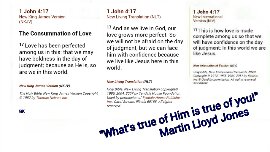
Believing what God already believes about you will change everything!
His beliefs about you are so much greater than anything you will even be able to remotely comprehend!
Let Him establish your identity no other source. All others sources for your identity are inferior. His beliefs and view of you are perfect. Rest in that thought…..
2 Corinthians 3:18
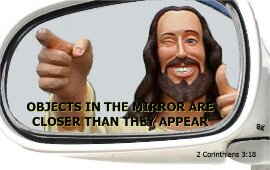
The days of window-shopping are over! In him every face is unveiled. In gazing with wonder at the blueprint likeness of God displayed in human form, we suddenly realize that we are looking at ourselves! Every feature of his image is mirrored in us! This is the most radical transformation engineered by the Spirit of the Lord; we are led from an inferior mind-set to the revealed endorsement of our authentic identity. Mankind is his glory!
A mirror shows what is directly in front of it. It does not show a past or future version of what is in front of it but that which is there at that immediate moment. He is mirrored perfectly in us, we are mirrored perfectly in Him right now.
He is my identity! What’s true of Him is true of you!
(The word, anakekalumeno, is a perfect passive participle from anakalupto; ana, a preposition denoting upward, to return again, and kalupto, to uncover, unveil. The word, katoptrizomenoi, is the present middle participle from katoptrizomai, meaning to gaze into a reflection, to mirror oneself. The word metamorphumetha is a present passive indicative from metamorpho; meta, together with, and meros, form. [The word commonly translated for sin, hamartia, is the opposite of this as ha, means without, and meros, form.] The word, eikon, translates as exact resemblance, image and likeness; eikon always assumes a prototype, that which it not merely resembles, but from that which it is drawn; doxa, glory, translates as mind-set, opinion from dokeo, authentic thought. Changed ‘from glory to glory’, apo doxes eis doxan; eis, a point reached in conclusion; apo, away from, meaning away from the glory that previously defined us, i.e. our own achievements or disappointments, to the glory of our original design that now defines us. [Paul writes in Romans 1:17 about the unveiling of God’s righteousness and then says it is from faith to faith. Here he does not use the word apo, but the preposition, ek, which always denotes source or origin.] Two glories are mentioned in this chapter; the glory of the flesh, and the unfading glory of God’s image and likeness redeemed in us. The fading glory represented in the dispensation of the law of Moses is immediately superseded by the unveiling of Christ in us! Some translations of this scripture reads, “we are being changed from glory to glory.” This would suggest that change is gradual and will more than likely take a lifetime, which was the typical thinking that trapped Israel for forty years in the wilderness of unbelief! We cannot become more than what we already are in Christ. We do not grow more complete; we simply grow in the knowledge of our completeness! [See Col 3:10] We are not changed “from one degree of glory to another,” or step by step. How long does it take the beautiful swan to awaken to the truth of its design? The ugly duckling was an illusion! Whatever it was that endorsed the ‘ugly duckling’ mindset, co-died together with Christ!)
Share via Twitter Facebook etc

8 Signs of Hyper-Grace Churches
Can you have to much of God, seriously?


 Kilen's Spot